
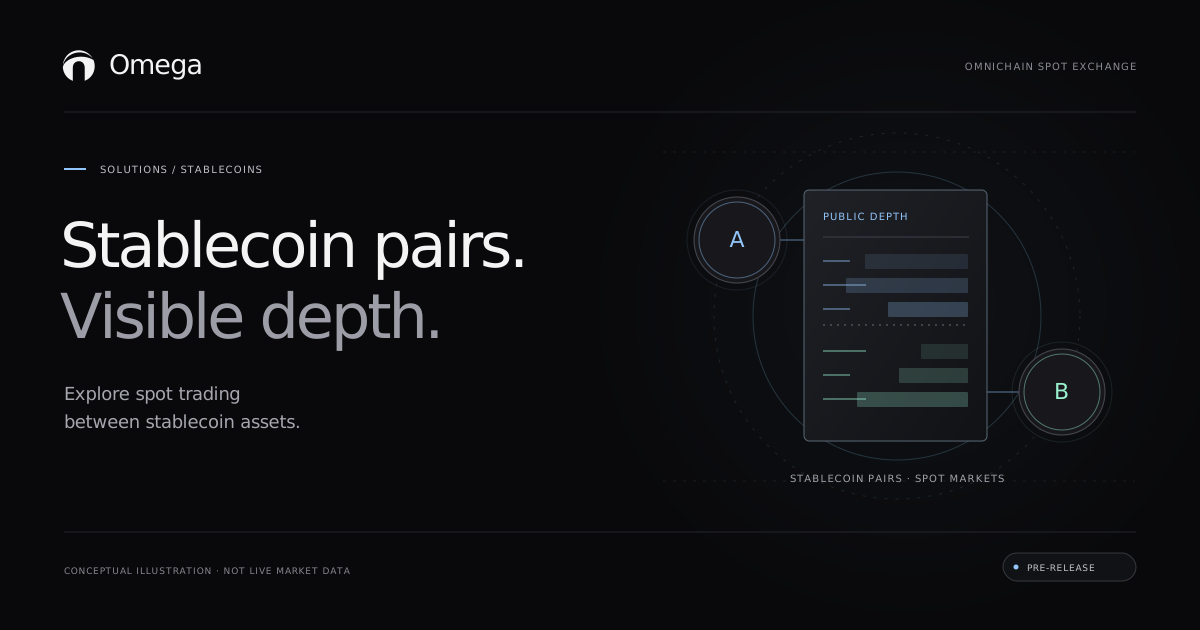
Bring a trading decision to scattered inventory
A trading team holds stablecoin inventory on several networks. It wants more of one asset for its next activity and less of another. Before placing a trade, it needs to know which representations it owns, which can enter the venue, what liquidity is available and where the output can subsequently go.
Omega's proposed role is a common spot-trading workflow for supported assets. The trader can examine public depth, choose an order and reconcile the account result. That gives the team a consistent way to reason about exchange execution while retaining the exact identity and movement conditions of each asset.
One trade, exact assets at every step
A conceptual pre-release workflow. Funding, order execution, account effects and any withdrawal retain separate states.
- 01Trading application
Identify assets
Bind exact input and output representations and confirm market availability.
- 02Omega exchange
Confirm funding
Reconcile admitted credit and available balance.
- 03Trader
Read the market
Inspect depth and choose bounded market or limit terms.
- 04Omega exchange
Reconcile execution
Record actual fills, remaining quantity and fee denominations.
- 05Trading application
Confirm the result
Reconcile account and settlement states; verify any onward route separately.
Treat the representation as part of the asset
Start by mapping the inventory to exact asset identities. Two tokens with similar names can have different issuers, contracts, networks or movement rules. A stablecoin label alone does not establish equivalence, a one-to-one exchange rate or an available route.
Omega's target asset catalogue identifies representations using their chain, token, decimals, ingress status and vault where applicable. Market metadata then binds the exact base and quote assets, precision and permitted increments. An integration should retain those identities even when its interface uses shorter display names.
For each input, verify eligible funding instructions and reconcile credited balances before trading. For the intended output, check what holding and withdrawal options are actually supported in the environment. An exchange between two representations and an external chain-to-chain transfer have different completion evidence.
Choose between available depth and a specified price
A market order expresses a decision to trade against available liquidity, subject to the economic bounds in the released contract. A limit order specifies a price constraint and can leave quantity awaiting a match. The choice depends on the team's acceptable price, desired quantity and willingness to wait.
Read the order book at the size you intend to trade. A best displayed price covers the quantity offered at that level; a larger trade may encounter further levels. A snapshot records observed liquidity and can change before execution. An indicative JIT estimate can assist preparation, but it neither reserves that liquidity nor guarantees a price.
The authorized instruction must bound what can be spent or received and account for fee treatment. Omega's examples illustrate such protections; final signing, fill and rejection policies require a released contract. Avoid building a customer promise around a draft field or assuming a policy that has not been specified.
A worked example: rebalance part of an account
Suppose a team has 12,000 units of imaginary stablecoin A credited to its account. It wants to exchange up to 4,000 A for imaginary stablecoin B. Assume both exact representations and their market are supported in this hypothetical environment. All amounts, prices and fees here are illustrative.
The team reviews a book showing 2,500 A of buying interest at 0.999 B per A, followed by 1,500 A at 0.997. If those levels become the actual fills, the first produces 2,497.50 B and the second 1,495.50 B. Combined gross output is 3,993 B.
Assume an illustrative exchange fee of 3 B. Net output is then 3,990 B, while the team's remaining A inventory is 8,000. An example economic instruction could allow at most 4,000 A input and require at least 3,980 B net output, provided the released contract can bind those exact limits and fees. These numbers demonstrate accounting; they do not describe a live order or an available protection contract.
After execution, the integration compares the actual fill records and fee entries with the account effects. The book preview is retained as context, while the fills establish what traded. The resulting 3,990 B balance does not itself confirm withdrawal to an external wallet. That movement, if supported and requested, follows its own contract and status checks.
Keep fills, balances and settlement aligned
An acknowledgement identifies accepted processing. Matching may subsequently produce fills, leave a remainder or reject the instruction. Each outcome must be read from the authoritative contract, with order, fill and operation identities preserved for reconciliation.
In the example, if only the first 2,500 A fills, the remaining 1,500 A is a separate quantity to track. A cancellation request may race another fill. Wait for the authoritative outcome before treating the remainder as cancelled or releasing its committed funds. Earlier fills and their fees remain part of the record.
Likewise, available, reserved, provisional and finalized observations must be interpreted in their documented dimensions. Alternative account views do not create extra money. Matching completion, ledger effects and final settlement should remain distinguishable even if the interface summarizes them into a compact progress display.
Make recovery part of the trading workflow
Retain the original instruction and idempotency identity before submission. If the response is lost, use the released authoritative lookup or exact-key recovery process. Resubmitting under a new identity can create a second trade. A stream reconnect also needs state reconciliation; it cannot establish by itself whether the original order filled.
Private account views require authorized access and should stay out of public logs. Public market depth supports market observation, while the account view supports the owner's inventory decisions. Omega's operator can see transactions. Its TEE-based verification supports execution verification without making those transactions operator-blind.
Build against the supported market
This workflow is grounded in Omega's pre-release exchange direction: market and limit orders, public depth, private account balances and indicative JIT estimates. The documentation describes a target API, with production access, signing and several funding and recovery details still unresolved.
Start an integration discussion with the precise representations, expected order sizes and required onward routes. Those details determine whether the proposed market solves the team's actual inventory problem. Broader asset coverage and universal movement should remain separate questions until the corresponding support is established.
Pre-release exchange workflow based on the target API. Examples use imaginary assets and synthetic arithmetic. Live markets, fees, asset support and withdrawal routes are not established by these examples.
Read the specification
Continue reading
Discuss your workflow.
Share the assets, participants and routes your integration needs.
Discuss your workflow