
Start with what the recipient needs
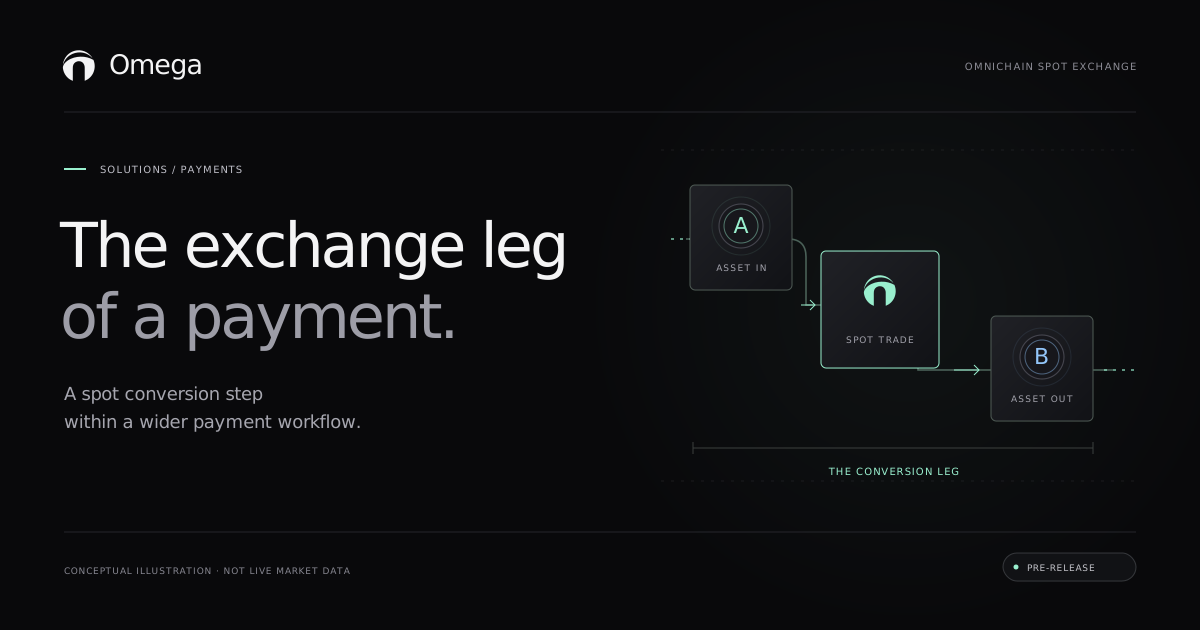
A customer holds one stablecoin. Their supplier wants another, on a particular network, in a wallet the payment provider has checked. Completing that payment requires several decisions: which exact assets to exchange, how much the customer authorizes, where the resulting funds can move and what evidence closes the payment.
For a payment service provider, the opportunity is to put those decisions into one understandable customer journey. Omega could supply the spot-conversion component. The provider still owns the customer relationship, the payment instruction, applicable checks and the delivery arrangement. Designing that boundary early makes the experience easier to explain and recover when something changes.
From payment instruction to confirmed delivery
A conceptual integration. Exchange execution, settlement and external delivery each require their own evidence.
- 01Payment application
Define the payment
Exact assets, recipient, spend limit and required output.
- 02Omega exchange
Reconcile funding
Follow eligible instructions and confirm admitted account credit.
- 03Owner + Omega exchange
Authorize and trade
Record accepted terms, order identity, fills and fees.
- 04Payment application
Reconcile the result
Check account effects, settlement and movement eligibility separately.
- 05Delivery provider
Confirm delivery
Complete the separately established route and verify receipt.
Define the instruction before showing a price
Begin with the input asset and the recipient's required output. Retain the exact token representation and chain for each. A familiar symbol is useful on screen, but it cannot establish where funds should be sent or whether two representations are interchangeable.
The provider also needs to decide what the customer is approving: a maximum input, a minimum received amount, or another clearly bounded instruction supported by the eventual execution contract. Fees need their own amounts and denominations. Delivery charges belong in the payment calculation alongside exchange charges, even when different systems collect them.
Check that the relevant market, funding route and onward route are available before presenting a usable payment path. Omega's current documentation does not supply a universal support matrix or arbitrary destination-chain delivery. An unavailable route should stop the proposed payment before the customer sends funds.
Fund the exchange leg and authorize the trade
For an eligible asset, funding follows registered instructions that bind its representation, route and reference. The application then reconciles admission and account credit. Seeing a transfer on a source chain is insufficient evidence that the exchange balance is available to trade.
Public market depth helps the provider assess the conversion. An indicative just-in-time estimate may also help prepare it. Both are observations that can change. A JIT estimate does not reserve inventory, fix a rate or authorize execution.
Before a trade is submitted, the customer or another authorized owner must accept the actual economic terms. API access and spending authority are separate. Omega's target API includes market and limit orders, while the production signing envelope and several execution policies remain unresolved. An integration must implement against the released contract, rather than treating the illustrative documentation as a live payment API.
A worked example: account for both legs
Consider two imaginary stablecoins, A and B. Assume the chosen representations, exchange market and separate delivery route have been approved for this hypothetical workflow. Every price and fee below is invented arithmetic, not an Omega rate, fee schedule or supported pair.
The customer authorizes a maximum exchange input of 10,000 A. In the example, execution converts that amount at 0.998 B per A, producing 9,980 B before exchange fees. An assumed 10 B exchange fee leaves 9,970 B. The authorization would need to bind the applicable receive limit and fee treatment under the released contract.
The provider records the actual fill, fee and resulting account balance, and checks the relevant settlement and movement conditions. Its separate delivery arrangement charges an illustrative 5 B, leaving 9,965 B for the recipient if that delivery completes as specified. The customer-facing calculation therefore shows the exchange output, delivery charge and intended recipient amount separately.
The payment closes only after the delivery system supplies the required confirmation and the provider reconciles it to the original instruction. The 9,970 B exchange balance alone does not establish that the recipient received 9,965 B.
Give each system its own completion check
Keep the payment identifier connected to the order, fills, account movements and any delivery identifier. An accepted order, a recorded fill, a ledger effect and final settlement answer different questions. A withdrawal adds further observations, potentially including claimability and a payment transaction.
An internal same-asset transfer can move funds between eligible Omega accounts. It preserves the asset representation; it does not perform another conversion or pay an external bank or wallet. If a bank payout is part of the product, the provider must establish that service and its evidence separately.
These distinctions can still produce a simple interface. The customer can see a small number of accurate milestones, while the provider retains the detailed records needed to explain an unexpected delay or reconcile a completed payment.
Recover the unfinished step
Suppose the conversion succeeds and onward delivery fails. The provider still has a completed conversion and an account balance to reconcile. Retrying the entire customer journey could perform a second trade. Recovery should identify the failed movement and proceed under its own authority and delivery contract.
A lost order response needs the original request identity and the contract's authoritative recovery path. A new request key can create another economic instruction. Stale pricing, insufficient liquidity or changed delivery terms may instead require a revised proposal and fresh acceptance. Do not hide those changes behind an automatic retry.
Where Omega fits today
Omega's pre-release scope is a verifiable omnichain spot exchange with public market depth and private account views. Its operator can see transactions; TEE-based execution verification does not make the operator blind. Payments are an application around that exchange, with additional customer, delivery and reconciliation systems.
The practical next step is to define one specific asset pair and delivery path, then map the evidence required at every handoff. Omega's current docs describe a target API; hosted integration details and final execution, funding and recovery contracts still need to be released. Fiat ramps, bank payouts and guaranteed arrival are outside the present documented offering.
Application study based on Omega’s pre-release target specification. Examples are hypothetical. No live asset support, fee, delivery route or payout guarantee is implied.
Read the specification
Continue reading
Discuss your workflow.
Share the assets, participants and routes your integration needs.
Discuss your workflow